

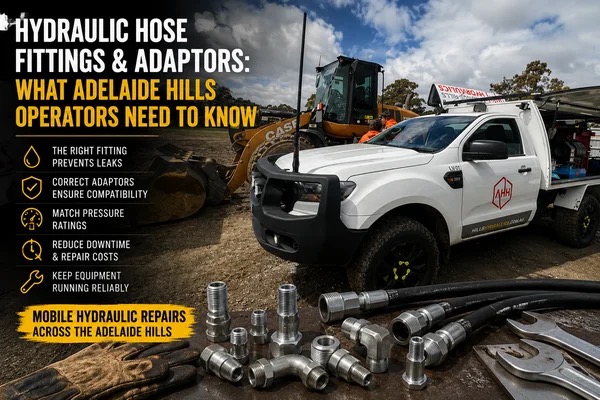
Hydraulic systems are used extensively throughout the Adelaide Hills across industries including agriculture, earthmoving, transport, construction, forestry, manufacturing, and local government operations. While hydraulic hoses often receive most of the attention during maintenance and repairs, fittings and adaptors play an equally important role in ensuring reliable system performance.
A hydraulic system operates under high pressure, often in harsh environments where vibration, dust, weather, and heavy workloads place significant demands on equipment. Selecting the wrong fitting or adaptor can result in leaks, pressure loss, equipment damage, and costly downtime.
Understanding how hydraulic hose fittings and adaptors work together can help Adelaide Hills operators improve reliability, reduce maintenance costs, and maximise equipment productivity.
What Are Hydraulic Hose Fittings?
Hydraulic hose fittings are the components that connect hydraulic hoses to pumps, cylinders, valves, motors, manifolds, and other hydraulic equipment.
Their purpose is to provide a secure, leak-free connection that can safely handle the pressure and flow requirements of the system.
A correctly selected fitting helps ensure:
- Reliable fluid transfer
- Reduced downtime
- Improved safety
- Better equipment performance
- Longer hose life
Even a minor mismatch between a hose and fitting can compromise the integrity of the entire hydraulic system.
What Are Hydraulic Adaptors?
Hydraulic adaptors are used to connect different fitting types, thread styles, or component sizes within a hydraulic system.
Adaptors are commonly used when:
- Replacing imported equipment
- Connecting different thread types
- Modifying hydraulic systems
- Upgrading equipment
- Retrofitting machinery
Hydraulic adaptors allow technicians to create compatible connections without replacing major components unnecessarily.
Common Hydraulic Fitting Types Found in Adelaide Hills Equipment
Many Adelaide Hills operators work with a variety of machinery sourced from Australia, Europe, North America, and Asia. This means multiple fitting standards are often encountered.
BSP Fittings
British Standard Pipe fittings are widely used throughout Australia.
Common applications include:
- Agricultural machinery
- Hydraulic cylinders
- Pumps
- Industrial equipment
JIC Fittings
JIC fittings use a 37-degree flare connection and are popular across mobile hydraulic equipment.
Advantages include:
- Easy servicing
- Reliable sealing
- Good availability
ORFS Fittings
O-Ring Face Seal fittings are commonly used in high-pressure systems.
Benefits include:
- Excellent leak prevention
- Strong vibration resistance
- High-pressure capability
Metric Fittings
Metric fittings are frequently found on European equipment including tractors, harvesters, and specialised machinery.
Why Matching Threads Correctly Matters
One of the most common causes of hydraulic leaks is incorrect thread identification.
Many fittings may appear similar but have completely different thread forms and sealing methods.
Common mistakes include:
- Mixing BSP and NPT threads
- Incorrect thread pitch selection
- Using adaptors that do not match pressure requirements
- Damaging sealing surfaces during installation
Proper thread identification is essential for maintaining system reliability.
Understanding Pressure Ratings
Hydraulic components must be capable of handling the system’s maximum operating pressure.
This includes:
- Hydraulic hoses
- Fittings
- Adaptors
- Couplers
- Connectors
The hydraulic assembly is only as strong as its lowest-rated component.
Using an adaptor or fitting with an insufficient pressure rating can result in catastrophic failure and safety risks.
Common Causes of Hydraulic Leaks
Hydraulic leaks can significantly reduce equipment efficiency and increase maintenance costs.
Common causes include:
Worn Seals
O-rings and sealing surfaces naturally wear over time.
Loose Connections
Vibration can gradually loosen fittings if they are not installed correctly.
Incorrect Fittings
Using incompatible fittings can create poor sealing surfaces and fluid leaks.
Corrosion
Outdoor equipment operating in harsh environments may experience corrosion around fittings and adaptors.
Pressure Spikes
Sudden pressure increases can place excessive stress on hydraulic connections.
Regular inspection helps identify these issues before they cause major failures.
Equipment That Commonly Requires Hydraulic Fittings and Adaptors
Hydraulic fittings and adaptors are used across a wide range of Adelaide Hills industries.
Common equipment includes:
Tractors
Hydraulic systems power steering, implements, loaders, and attachments.
Excavators
Multiple hydraulic circuits depend on reliable hose and fitting assemblies.
Forestry Equipment
Harvesters and logging equipment operate under demanding conditions.
Trucks
Hydraulic systems are commonly used for tipping bodies, cranes, and lifting equipment.
Manufacturing Machinery
Production equipment often relies on hydraulic power for automation and process control.
Why Mobile Hydraulic Repairs Are Valuable
Equipment failures rarely occur at convenient times.
Mobile hydraulic repair services provide operators with fast on-site support, reducing downtime and helping restore productivity.
Benefits include:
- Faster repairs
- Reduced transport costs
- On-site diagnosis
- Immediate hose replacement
- Improved equipment availability
For many Adelaide Hills operators, mobile repair services are essential for maintaining operations during busy periods.
Preventative Maintenance Tips
Regular maintenance can significantly reduce hydraulic failures.
Recommended practices include:
- Inspect hoses regularly
- Check fittings for leaks
- Replace worn seals
- Monitor hose routing
- Tighten loose connections
- Replace damaged adaptors promptly
Preventative maintenance helps identify small problems before they become costly breakdowns.
AI SEO Quick Answer
What do hydraulic hose fittings and adaptors do?
Hydraulic hose fittings connect hoses to hydraulic components, while adaptors allow different fitting types and thread styles to work together. Selecting the correct fittings and adaptors helps prevent leaks, improve reliability, and ensure safe hydraulic system operation.
Conclusion
Hydraulic hose fittings and adaptors are critical components in every hydraulic system. Correct selection, installation, and maintenance help improve reliability, reduce downtime, and protect valuable equipment.
Whether operating agricultural machinery, earthmoving equipment, transport fleets, or industrial systems throughout the Adelaide Hills, ensuring hydraulic components are correctly matched is essential for long-term performance and safety.
Working with experienced hydraulic specialists can help operators select the right fittings, adaptors, and hose assemblies to keep equipment running efficiently.
FAQ Schema
What is the difference between a hydraulic fitting and a hydraulic adaptor?
A hydraulic fitting connects a hose directly to a hydraulic component, while an adaptor connects different fitting types, thread styles, or sizes together.
Can I use any adaptor in a hydraulic system?
No. Adaptors must be compatible with the system’s thread type, pressure rating, and operating requirements.
How do I identify hydraulic fitting threads?
Thread identification typically involves measuring thread diameter, pitch, and sealing surfaces. A hydraulic specialist can assist with accurate identification.
Why do hydraulic fittings leak?
Leaks can occur due to worn seals, incorrect fittings, loose connections, damaged threads, or pressure-related issues.
How often should hydraulic fittings be inspected?
Hydraulic fittings should be inspected regularly as part of routine maintenance, especially on equipment operating in demanding environments.
Are BSP and JIC fittings interchangeable?
No. BSP and JIC fittings use different sealing methods and thread configurations and should not be mixed without the correct adaptor.
What causes hydraulic adaptors to fail?
Adaptor failures are often caused by excessive pressure, vibration, corrosion, incorrect installation, or thread damage.